
What Is an Active Break? Changing Position at a Desk
An active break is a short interval that changes position and movement. We explain how it differs from a passive break, how often to take one, and what to do in 1–3 minutes.
Body awareness is a learnable skill that makes it easier to sense and manage movement. This page explains the place of this skill in a physiotherapy process.
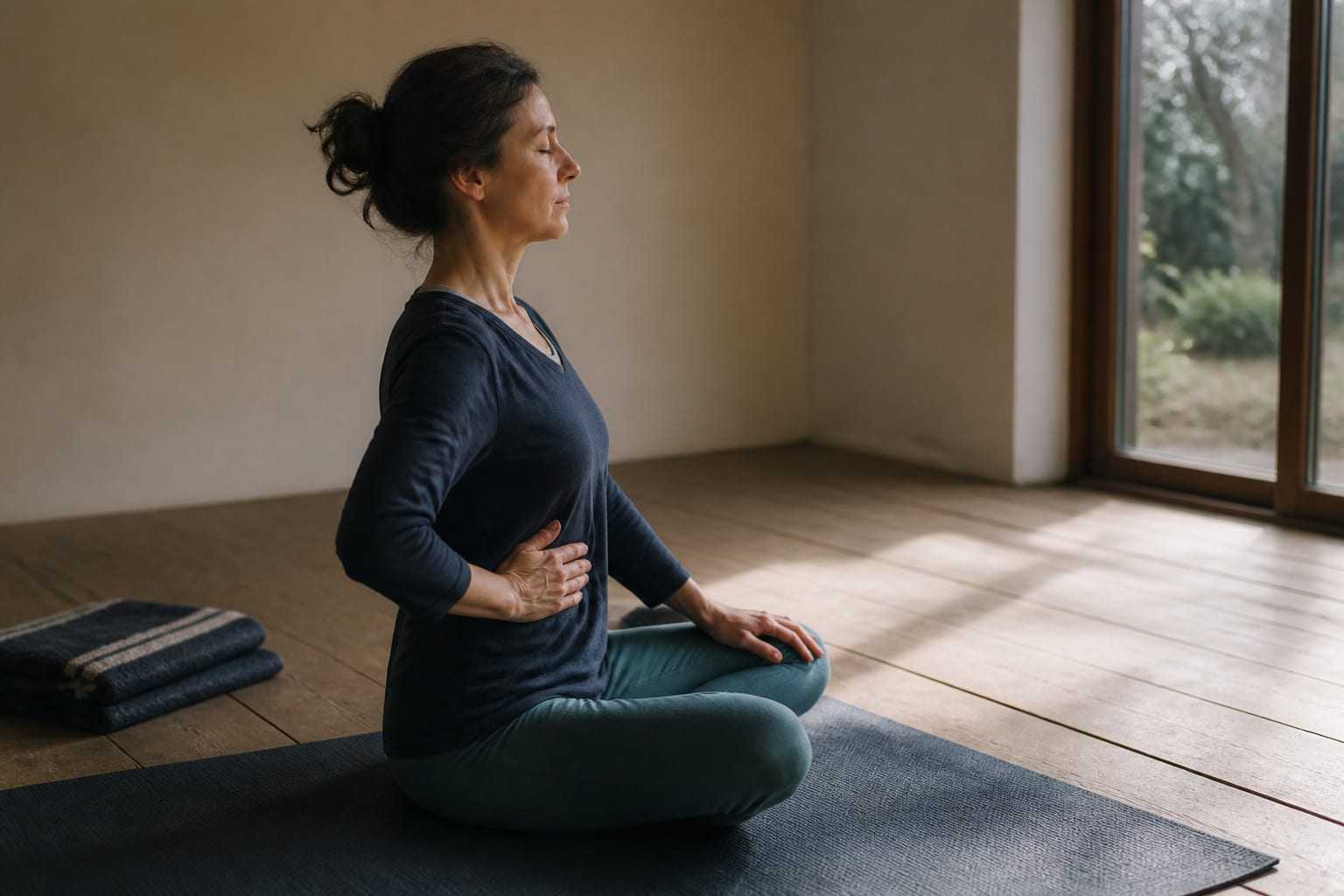
Body awareness is the skill of noticing the body’s position, movement and level of tension. This information comes largely from receptors in muscle, joint and connective tissue; this sense, called proprioception, lets us manage movement without needing to control it with the eyes.
Awareness can look abstract, but its everyday counterparts are very concrete: noticing that the shoulder has stayed pulled up through the day, catching a habit of clenching the jaw, seeing that the breath is being held during a movement, or sensing the point at which tiredness begins. A habit that is noticed becomes something that can be worked on.
This skill is not fixed. Like other skills, it becomes clearer with use and recedes when it is left aside for a long time. Needing to focus on every detail when learning a new movement, then having the movement flow of its own accord with repetition, is an everyday example of this learning.
In complaints that last a long time or keep returning, perception of certain regions of the body can change. The person limits movement to protect against pain, uses a region less, or moves more cautiously than usual. These responses are understandable in the short term; over the longer term they can reduce variety of movement.
Awareness work comes in at this point. The aim is not to memorise a correct posture, but to increase options: being able to do the same task in different ways, being able to let go of tension where it is not needed, being able to start moving again with confidence.
This work does not replace exercise. It is a component that raises the quality of exercise and helps the person gather better information about their own body.
On a busy day the breathing pattern can become shallow and the shoulder girdle can stay in a constant state of readiness. These responses are not harmful in themselves; when they continue for a long time they can become an extra load that affects musculoskeletal comfort.
Noticing the rhythm of the breath, letting the shoulder girdle go a few times during the day, or taking a short pause after finishing a task are adjustments that do not need complex techniques and whose effect can accumulate over time. They are often planned together with ergonomic adjustments.
The aim here is not to ask the person to monitor themselves constantly; that would be a load that is hard to carry through the day. What is more workable is to tie awareness to particular moments in the day: a short check when a meeting ends, when a call closes, or when standing up for a drink can, over time, become a habit that runs of its own accord.
The process starts with watching the person’s movement together. In which movements tension increases, which region is used less, how the person describes their own movement. Assessment here is not a performance measurement; it is a shared observation.
The person’s own account is especially valuable during observation. How a movement feels, at which moment it becomes harder, or where hesitation appears is not always visible from the outside. That is why assessment takes measurement and the person’s description together.
Awareness is then developed with simple, repeatable practices: slowing the movement, trying the same movement at different speeds or with different support, working with the breath, making short checks at particular moments in the day. The practices are chosen so that they sit in the person’s daily routine.
This approach gains meaning when it is run together with an exercise programme and ergonomic adjustments. The aim is that the person can read more clearly what is happening in their own body and can manage load during the day for themselves.
Movement, the pattern of tension and the person’s own description are reviewed together. This stage is not a performance measurement; it is a shared exploration.
What concrete situation the awareness work will serve is defined: the working day, the quality of exercise, or a return to a particular activity.
Plain practices such as slowing the movement, trying it under different support conditions and working with the breath are chosen; complex protocols are avoided.
The practices are tied to particular moments in the day and planned together with ergonomic adjustments, so that they do not become a separate load.
What has been noticed and what has changed is discussed at set intervals; the work is updated according to the person’s feedback.
No. Body awareness is a learnable skill and develops with regular, short attempts. At the beginning it can be hard to notice the movements; that is an ordinary part of the process and becomes clearer over time.
It does not. Awareness work does not provide the loading needed for strength and endurance. It is a complementary component that supports the quality of the exercise programme and the person’s skill in managing their own movement.
The aim is not to memorise a single correct posture. The goal of the work is to increase options and to make it easier to change position during the day. Trying to hold a fixed position often creates extra tension.
An active break is a short interval that changes position and movement. We explain how it differs from a passive break, how often to take one, and what to do in 1–3 minutes.

Office ergonomics is not a search for one correct posture. We explain, step by step, how to fit the worker, the work and the workstation together.

Factors that contribute to neck pain, what a physiotherapy assessment covers, and practical self-management principles for daily life.
What is appropriate for you can only be decided after an individual assessment.