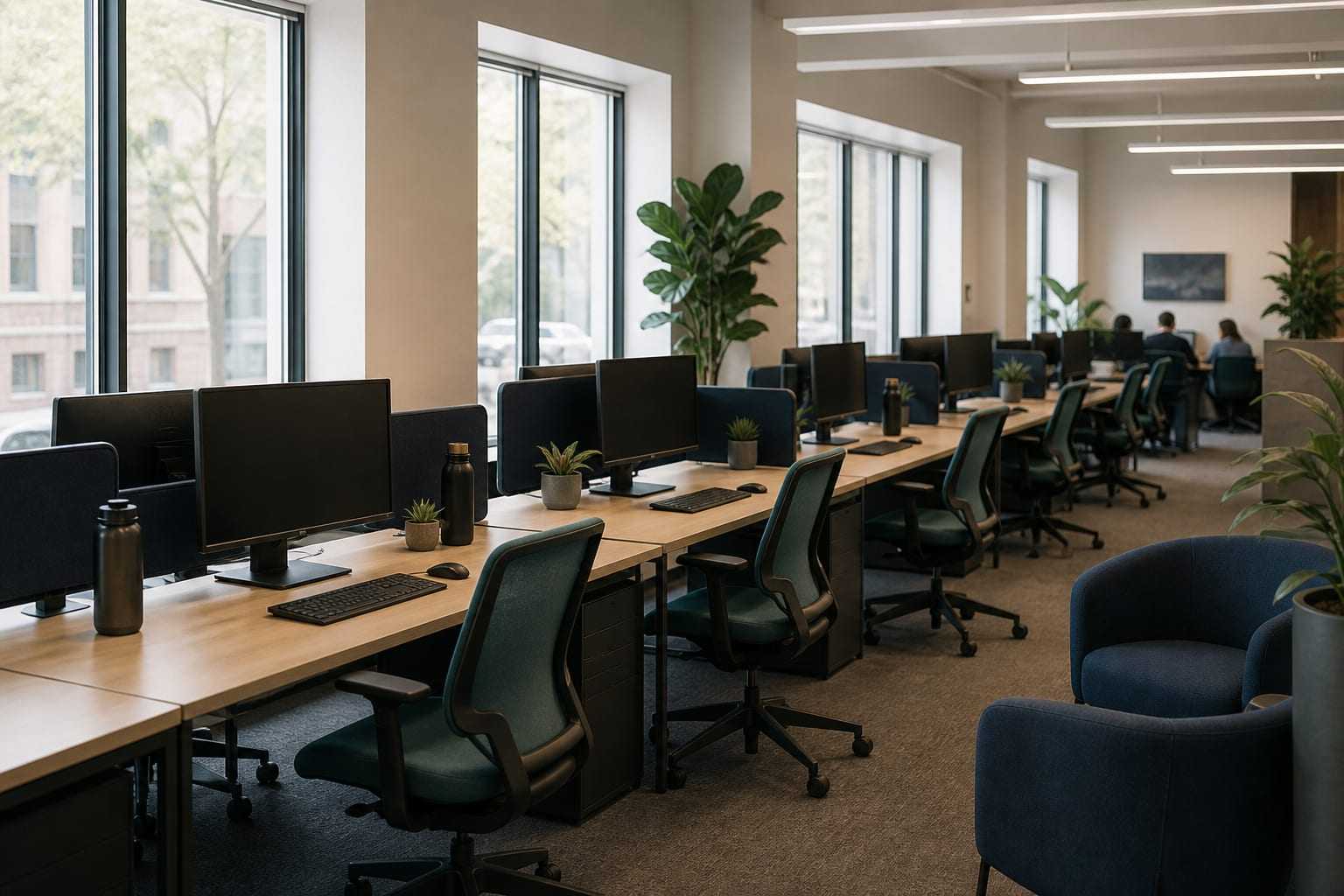
Office Ergonomics: Worker, Work and Workstation
Office ergonomics is not a search for one correct posture. We explain, step by step, how to fit the worker, the work and the workstation together.
An ergonomics piece of work that treats the office environment as a whole: physical setup, sitting behaviour and the amount of movement during the day are assessed together.
Office ergonomics is not only a matter of arranging desks one by one. Looked at from organisation level, which departments do similar tasks, which areas use the same furniture and equipment, how shared spaces and meeting setups are arranged, and how long employees stay in the same position during the day are treated as a whole.
This whole-organisation view makes it possible to see that similar mismatches repeat across the organisation. For example, screen height being systematically low in teams that use a particular desk type, or repetitive wrist movement concentrating in a particular task type, only becomes visible at organisation scale. Defining a pattern that can be corrected, rather than correcting stations one by one, lets the organisation use its resource more accurately.
The frame of the work is musculoskeletal health and ergonomic fit. The aim is to arrange the work environment so that it supports physical comfort and work continuity; assessment of individual complaints is a separate health theme and is handled with appropriate referral.
The picture most often seen in an office is good equipment that has not been adjusted for the person. An adjustable chair may have been bought; yet height, back support and armrest position may never have been set to the user’s measurements even once. In the same way, the distance and height of the screen relative to the user affect the load on the neck directly.
Using a laptop on its own at a fixed workstation is a separate theme. On a laptop the screen and keyboard sit in the same body; when the screen is brought to a suitable height the keyboard rises out of reach, and when the keyboard is brought to a suitable position the screen stays low. This structural constraint cannot be resolved without extra equipment or a change in layout.
A third common theme is that movement is not spread through the day. How many hours the employee sits matters, and so does whether that time is unbroken. Decisions such as meetings planned back to back, lunch taken at the desk, and frequently used materials sitting outside reaching distance affect movement during the day directly.
The assessment is carried out in the office area within the scope set in the needs analysis. The workstation and work behaviour are observed while employees do their usual work; a short conversation then gathers information about the work pattern during the day, position change and break habits.
Observations are interpreted by grouping them by task type and department, not person by person. That way the report gains a structure that is meaningful and workable for the organisation. Person-specific findings are shared with the employee; in the report presented to the organisation the findings appear in grouped form.
The assessment covers not only desks but also the office’s shared spaces. Sitting setup in meeting rooms, how adjustable shared stations are, areas where people work on laptops, and the circulation spaces employees use during the day are taken together. In setups without a fixed desk, the employee sitting at a different station each day is examined as a separate theme, because the adjustments have to be made again each time.
Participation is voluntary and the purpose of the assessment is explained to employees in advance. The work is not a performance observation; what is examined is not how the work is done, but the physical conditions in which it is done. Sharing this frame from the start makes it easier for employees to describe the points they find difficult, and it affects the quality of the assessment directly.
The first change is usually at the level of adjustment: chair height, back support, screen height and distance, the position of the keyboard and mouse on the desk, and bringing frequently used objects into reaching distance. A large share of these adjustments does not need extra investment and is achieved by using existing equipment correctly.
The second group of changes relates to work behaviour: changing position during the day, separating tasks that can be done standing, reviewing the work–break pattern, and spreading active breaks through the day. The third group relates to purchasing and layout decisions; which equipment is genuinely needed is prioritised on the basis of the assessment findings.
Whether these adjustments last depends on the employee knowing their own station and being able to make the adjustments themselves. That is why an office-ergonomics piece of work holds more consistently when it is planned together with employee training and a follow-up stage.
Reviewing layout, shared spaces and department-level working conditions from an ergonomic point of view.
Addressing desk height, use of the work surface and the reaching distance of frequently used objects.
Setting sitting height, back support and armrest position for the user and showing correct use.
Assessing and adjusting screen position in terms of load on the neck and shoulder region.
Addressing the position of input devices, forearm support and wrist loading in terms of repetitive movement.
Assessing layout and extra-equipment need for employees who use a laptop at a fixed station.
Assessing the position kept up during the day, static loading and how often position is changed.
Reviewing break organisation and preparing active-break recommendations that can be spread through the day.
The stages follow one another; scope and duration depend on the organisation.
The work begins with understanding the organisation’s own conditions. How many people do which work, how long employees stay at a desk during the day, which departments are exposed to similar physical loading, and which complaints are frequently raised in the organisation are discussed together with the organisation’s representatives. Office layout, the variety of furniture and equipment in use, the remote-work ratio and the existing break arrangement are recorded at this stage. In this way, which areas the assessment will focus on, and at what depth, are determined according to the organisation’s real need.
Workstations and work habits are assessed from an ergonomic perspective on site, or online for organisations with remote employees. Physical layout elements such as desk height, chair settings, screen position, keyboard and mouse placement, laptop use and reach distance to frequently used objects are considered together with sitting behaviour, how often position is changed, static loading and repetitive movement patterns. The assessment is not made to diagnose the person, but to describe the fit between the employee and the work environment. The observations obtained are grouped and interpreted by department and task type.
Workable adjustment recommendations are prepared for the mismatches seen in the assessment. Recommendations are gathered under rearranging the workstation, using existing furniture and equipment correctly, considering additional support elements where needed, adjusting work behaviour and changing position, and reviewing work–break organisation. Each recommendation is prioritised with the organisation’s current resources and work pattern in mind; matters that can first be addressed through settings and arrangement are separated out. In this way, the organisation sees clearly where it should begin.
Training for employees is adapted to the organisation and the employee profile. Instead of a general presentation, content is prepared that proceeds from the findings that stood out in the assessment and covers recognising one’s own station, adjusting settings to one’s own measurements, changing position during the day and building an active-break habit. The training conveys basic information on musculoskeletal health in plain language and shows what the employee can change in their own work pattern and how. A separate briefing can be planned for managers on what can be followed at team level.
After the adjustments have been applied, a re-assessment is made and the changed situation is recorded. Which recommendations have been put into practice, in which areas the fit has improved and which topics remain a priority are considered comparatively. The process is documented in a Corporate Ergonomics Assessment Report that contains the organisation’s own findings; the report includes both the current situation and a follow-up plan for the next steps. In this way, the ergonomics work ceases to be a one-off event and becomes an ongoing topic the organisation can follow.
A large part of the assessment rests on observation while the employee continues their usual work. The conversation with the employee is kept short and planned around the flow of work. In busy periods the assessment can be split across times when departments are available.
The assessment first separates the themes that can be resolved by using and adjusting existing equipment correctly. If a mismatch cannot be resolved by adjustment alone, it is stated clearly which equipment or layout change could address it. The purchasing decision belongs to the organisation; recommendations do not point to a particular brand or product.
The work can be planned both for small teams and for organisations with many departments. What sets the scope is variety of tasks as well as headcount; in teams that do similar work it is possible to proceed through representative stations.
The office-ergonomics work focuses on the work environment inside the office. For teams that work from home or on a rotating pattern, the Hybrid Work Ergonomics theme is planned separately; the two themes can be taken together in the same consultancy process.
Office ergonomics is not a search for one correct posture. We explain, step by step, how to fit the worker, the work and the workstation together.
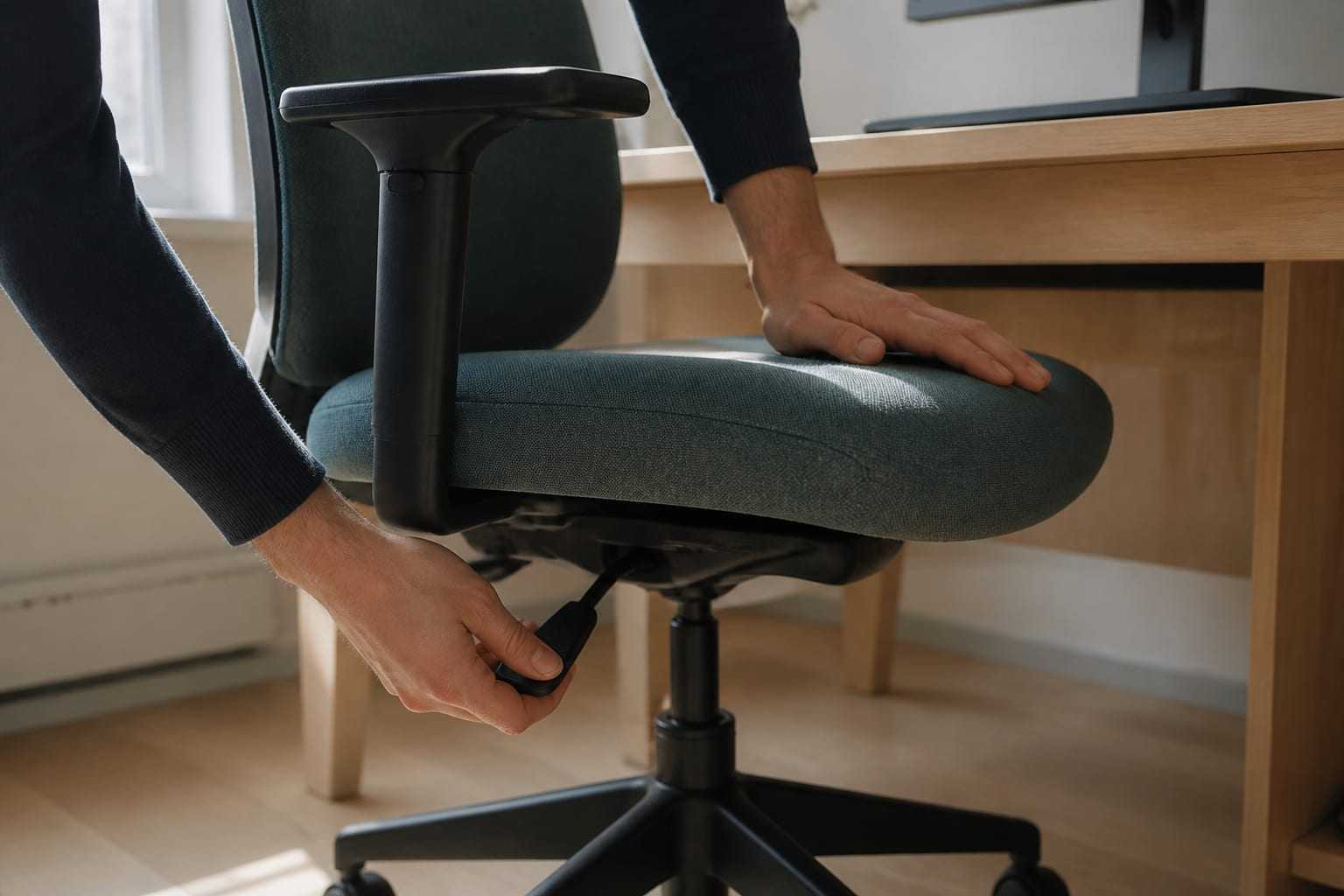
In what order should you adjust an office chair and desk? We walk through height, seat depth, lumbar support and armrest settings step by step.

Computer screen height, distance and tilt directly affect neck load. How do you set the screen for glare, dual monitors and text size?
Once headcount, work model and priority topics are clear, a process proposal can be prepared.