Neck Pain: Causes, Physiotherapy Assessment and Self-Management
Neck pain is often not tied to a single cause; loading, time spent in a position, activity level, sleep and workload play a role together.

Neck pain is one of the most frequently described complaints related to the musculoskeletal system. Most people experience pain, tightness or restricted movement in the neck region at some period of their life. This article has been prepared to explain neck pain in an understandable way, to show which factors may contribute to the picture, and to convey what a person can do for themselves. The content here is for information and does not take the place of an assessment specific to the person.
What is neck pain?
The neck is a mobile region made up of seven vertebrae, the discs between them, small joints, ligaments, muscles and the nerve structures that pass through this region. It carries the weight of the head while also offering a wide range of movement. Carrying out these two tasks together makes the neck region sensitive to changes in loading during the day.
Neck pain may be felt only in the neck, or it may also spread toward the top of the shoulder, the shoulder-blade region, the head or the arm. Clinical practice guidelines do not treat neck pain as a single category; pictures in which restricted movement stands out, pictures related to movement control, pictures accompanied by headache, and pictures in which signs radiating into the arm are present are defined separately. This distinction matters, because a suitable physiotherapy approach also varies with the picture.
In the large majority of complaints, a single structural damage cannot be shown. This does not mean that the pain is not real; it means that pain is an experience produced together by loading, the tissues’ sensitivity at that moment, the activity pattern and general health.
Why is neck pain so common?
Several reasons play a role together:
- The neck is in continuous use. Reading, looking at a screen, driving, speaking and doing hand work affect the position of the head and neck directly.
- Modern forms of work include a prolonged fixed position. In work-related musculoskeletal disorders, awkward and static positions, repetitive movements and little opportunity to change position are listed among known risk factors.
- Mechanical factors alone are not decisive. Organisational and psychosocial factors such as high workload, low decision latitude, an inadequate break pattern and low job satisfaction can also contribute to the picture.
Being common does not mean that neck pain is a serious problem. On the contrary, it being a frequent complaint with a favourable course in most cases shows that the area in which the person can take an active role in the process is wide.
Factors that contribute to neck pain
Loading and time spent in a position
There is no single “correct posture” that applies to everyone. In practice what is decisive is not so much the position itself as the time spent without interruption in that position. Ergonomics sources state this point clearly: however suitable the working position, remaining in the same position for a long time creates an expected load. For this reason “changing position regularly” is a more realistic aim than “finding the perfect posture”.
Physical activity level
The strength and endurance capacity of the muscles around the neck, shoulder and shoulder blade affects how comfortably you can meet the load during the day. A low general physical activity level can widen the gap between capacity and daily load.
Sleep
A reduction in sleep duration and quality can affect the pain experience. In many people with a complaint, sleep and pain become a cycle that feeds each other; that is why sleep pattern is also addressed in the assessment.
Stress and workload
Busy periods change not only mental load but also the form of work: breaks shorten, screen time lengthens, change of position decreases. The effect of stress on neck pain occurs both through these behavioural changes and through changes in pain sensitivity.
Setup of the work environment
Screen height, the desk–chair relationship, laptop use and time spent on the phone affect the distribution of load in the neck region. You will find details specific to desk work in the neck pain at a desk guide, and the work environment as a whole in the office ergonomics guide. At organisational scale, systematic examination of this pattern falls under workstation analysis.
What does a physiotherapy assessment look at?
The aim of the assessment is to understand which factors the complaint appears to be related to and to plan a physiotherapy approach suitable for the person. The following headings are usually addressed:
- History: when and in what context the complaint started, how it changes during the day, what increases it and what reduces it.
- Behaviour and spread of the pain: presence of signs radiating into the arm or the head, descriptions of numbness or loss of strength.
- Movement: neck range of movement, the quality of the movement, the contribution of the thoracic region and the shoulder girdle.
- Muscle control and endurance: the response of the muscles around the neck and shoulder blade to loading.
- Daily loading profile: work pattern, screen time, break behaviour, sleep, physical activity level.
- Thoughts and behaviours related to pain: which movements are avoided and how this narrows daily life.
This assessment is the starting point of the neck and spine health service. In pictures where movement quality and body awareness stand out, a body awareness approach may also be part of the plan.
Basic principles of self-management
The following principles are not a treatment protocol, but a general framework that applies to most people:
- Do not stop movement altogether. Prolonged complete rest is generally not helpful. Continuing tolerated movement protects the region’s adaptation to loading.
- Create variety of positions. Moving among a few different working positions during the day is a more effective strategy than trying to perfect a single position.
- Increase the load gradually. When returning to an activity you have paused, raising a single variable gradually, rather than increasing duration and intensity at the same time, makes adaptation easier.
- Combine breaks with movement. Short, frequent pauses are easier to sustain than long, infrequent ones. Practical approaches on this topic are set out in the active break guide.
- Do not neglect sleep and general activity. These are not “side headings”; they are factors that affect the pain experience directly.
- Do not read the intensity of the pain as a measure of damage. Pain does not always show a linear relationship with the state of the tissue; this allows you to make more flexible decisions while managing pain.
Movement and exercise: what does the evidence say?
Exercise is one of the most studied approaches in neck pain. The summary of the Cochrane systematic review sets out the following framework:
- In long-standing neck pain, strengthening work covering the neck, shoulder and shoulder-blade region is supported by moderate-level evidence for pain and function.
- Programmes in which strengthening is combined with endurance or flexibility work have also been found useful.
- When stretching alone is done, the effect on pain and function is reduced to a minimum.
- Exercise is reported to be generally safe, and side effects to be temporary and mild.
- By contrast there is no high-quality evidence, and the most suitable dosage (frequency, sets, intensity) is still not clear.
That is why exercise selection is made according to the person: the aim, current capacity, tolerated movements and fit with the daily programme are assessed together. Raising the general physical activity level is also an inseparable part of this plan; details are addressed in the exercise and physical activity service. The World Health Organization recommends at least 150 minutes of moderate-intensity physical activity per week for adults and separately emphasises limiting sedentary time.
A neck complaint is often described together with the shoulder girdle. We address the relationship of these two regions in the shoulder pain in office workers guide. For the counterpart of the same loading logic in the low-back region, see the low back pain guide.
When should you see a health professional?
The following situations are uncommon in people who experience neck pain. They are listed here not to create anxiety, but to make clear the boundaries at which asking for assessment, rather than waiting, is appropriate.
Situations that need assessment without delay:
- Neck pain that started after a marked trauma such as a fall, a traffic accident or a direct blow
- Progressive loss of strength in the arm, loss of skill in the hand, numbness or tingling that is spreading
- A change in walking and balance, marked difficulty in hand–arm coordination
- Fever, unexplained weight loss, continuous pain that does not ease with rest through the night, general fatigue
- Newly started neck pain in the presence of conditions such as a known history of cancer, long-term corticosteroid use, or osteoporosis
- Accompanying signs such as a severe and unusual headache, a change in vision, difficulty speaking, difficulty swallowing, clouding of consciousness, or a feeling of fainting
The signs in this last group require urgent assessment; they should not be managed through article content.
Other situations in which making an appointment is reasonable:
- The complaint not easing as expected within a few weeks
- Pain that affects sleep, work or daily activities in a marked way
- Frequently recurring episodes and, related to this, an increasing tendency to avoid activities
- Not being sure what to do; a structured assessment and a clear plan often take a faster path than weeks spent on trial and error
If you wish to address your neck complaint with a physiotherapy assessment, you can learn about the process from the neck and spine health page. If you are speaking of an urgent picture, go first to the nearest health facility.
This article is for general information and is not a personal assessment, diagnosis or treatment. The reason for your symptoms and what is appropriate for you can only be decided after an in-person assessment.
Sources
- Neck Pain: Revision 2017 — clinical practice guidelineJournal of Orthopaedic & Sports Physical Therapy 2017;47(7):A1–A83. American Physical Therapy Association, Orthopaedic Section.
- Exercises for mechanical neck disorders — Cochrane systematic reviewCochrane Database of Systematic Reviews, CD004250. Summary of the evidence level on exercise approaches in neck pain.
- EU-OSHA — Musculoskeletal disordersEuropean Agency for Safety and Health at Work: physical, organisational and psychosocial risk factors in work-related musculoskeletal disorders.
- WHO — Guidelines on physical activity and sedentary behaviourWorld Health Organization, 2020. Physical activity recommendations for adults and the recommendation to limit sedentary time.
Frequently asked questions
How long does neck pain take to ease?
Duration varies with the person and the features of the picture. Most neck complaints that appear after a strain ease markedly within days to a few weeks; a portion may recur from time to time. The complaint lasting longer than expected, or affecting your daily work and sleep in a marked way, is a good reason for assessment.
Is an MRI or X-ray needed for neck pain?
Imaging is not needed in every neck pain. Imaging gains meaning when particular findings or warning signs are present in the clinical assessment. In addition, age-related changes found on imaging can also be seen in people without pain, so the findings are not always a direct explanation of the pain. Necessity is decided after a physician’s assessment.
Can I continue sport when I have neck pain?
It is generally more appropriate to arrange the load temporarily rather than stopping movement altogether. Movements that increase the pain markedly can be reduced for a time; tolerated activities such as walking can be continued. How the content of training is adapted is planned according to the person’s complaint and aim.
Could my pillow be the cause of my neck pain?
Pillow and bed arrangement can affect comfort during sleep, but reducing it to a single cause is not correct. An arrangement that increases comfort in sleep is usually helpful; by contrast there is no strong evidence showing that a particular pillow type is suitable for everyone.
Should heat or cold be applied for neck pain?
The evidence on this is limited and preference differs greatly among people. Short-term heat or cold application can provide temporary relief; a clear superiority between the two has not been shown. These applications should be thought of alongside, not instead of, arranging movement and activity.
Other articles on this topic

Neck Pain at a Desk: Screen, Laptop and Break Pattern
Neck pain in desk work: time in a fixed position, screen height, laptop and phone use, break behaviour and practical adjustments.
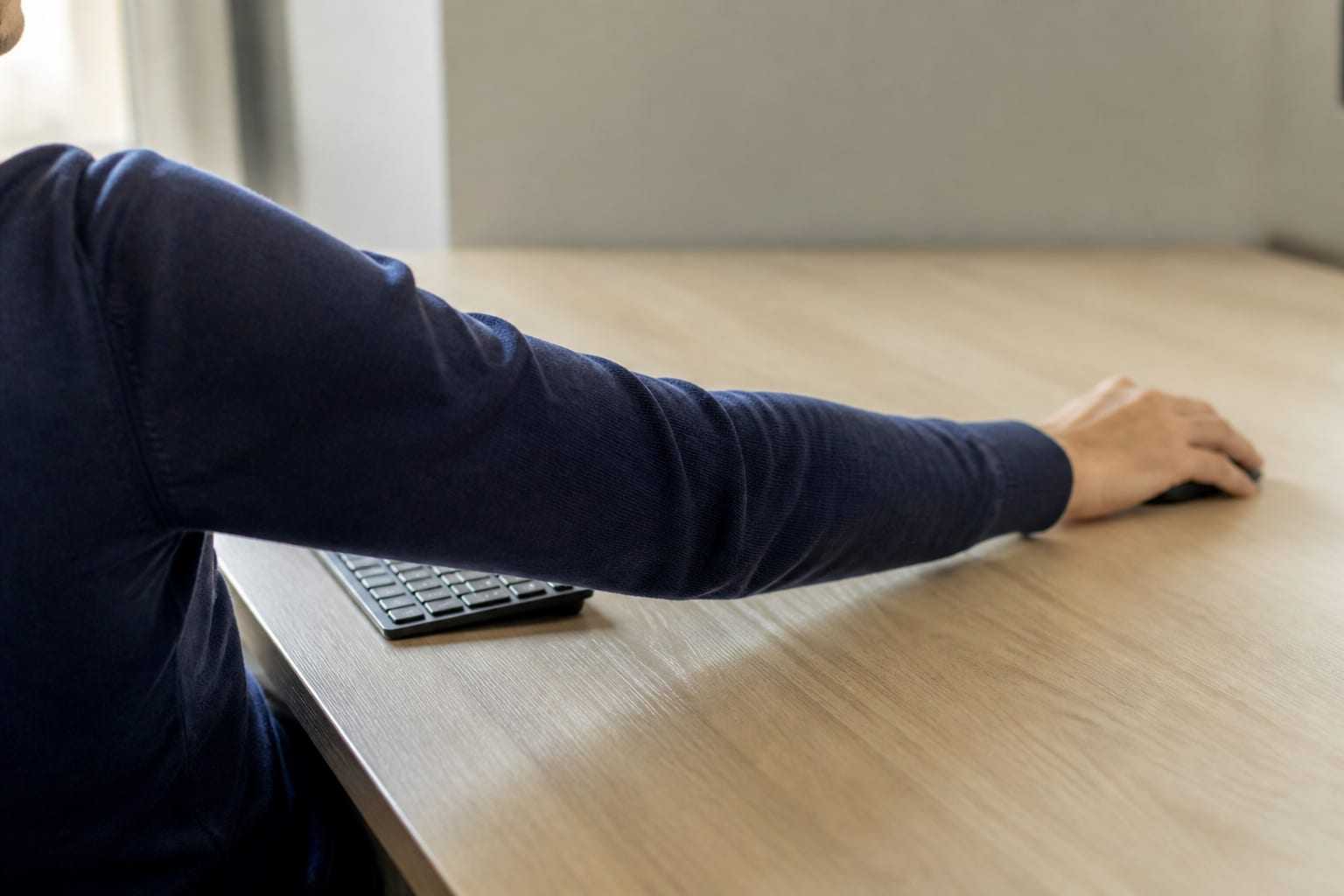
Shoulder Pain in Office Workers: Loading, Reach and Variety of Movement
In desk workers, shoulder symptoms are often linked to sustained low-level loading. We explain the role of mouse reach, armrests and movement variety.

Office Ergonomics: Worker, Work and Workstation
Office ergonomics is not a search for one correct posture. We explain, step by step, how to fit the worker, the work and the workstation together.