What Is an Active Break? Changing Position at a Desk
An active break is not stopping work; it is changing position and movement. Short, frequent intervals are generally more useful than long, infrequent ones.
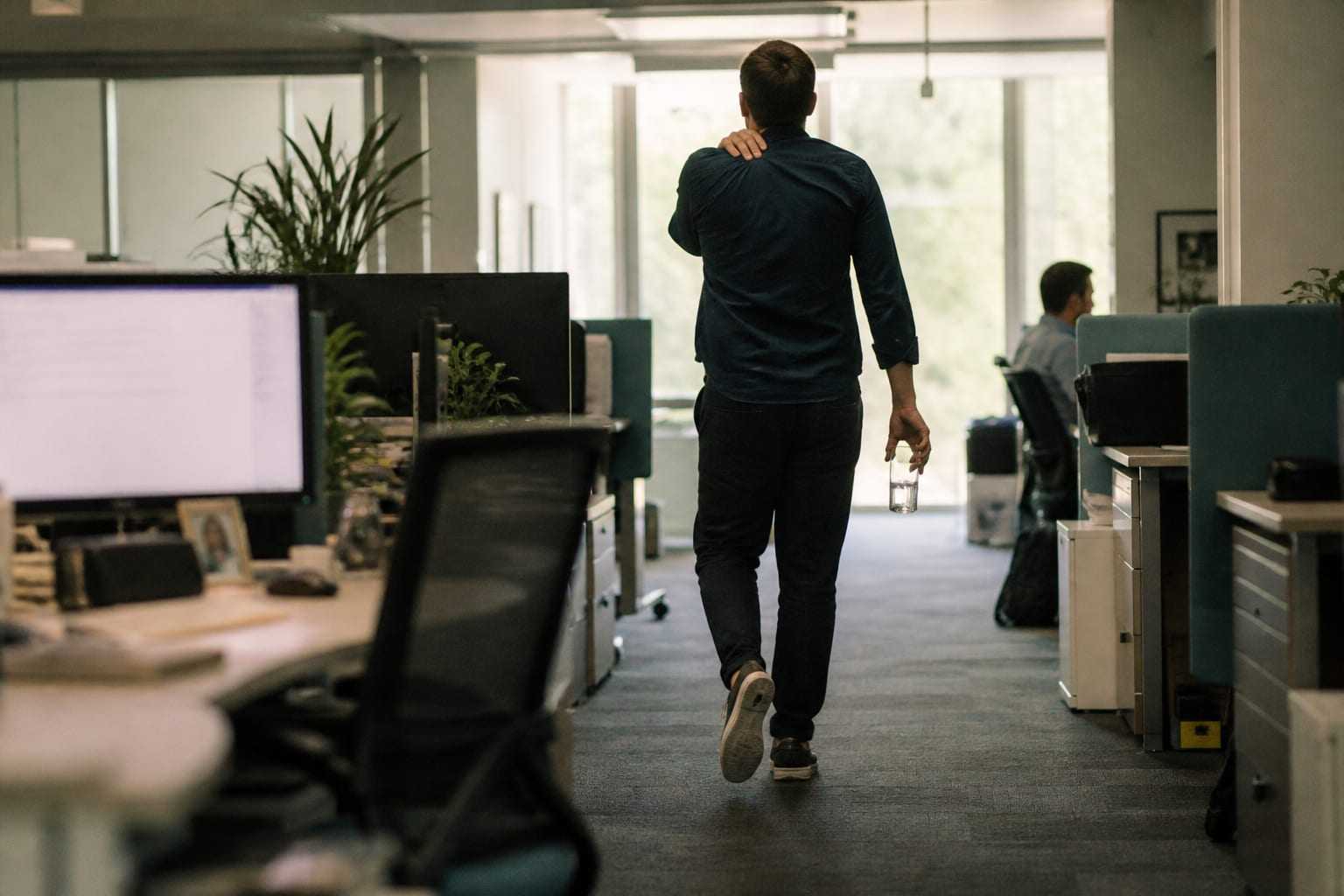
An active break is not stopping work; it is changing position and movement. Standing up for a minute or two, walking as far as the corridor, changing your sitting position in a noticeable way, or taking a phone call standing all fall under this definition.
These intervals are still needed even when the ergonomic setup is excellent. Workstation setup determines the quality of the load; the break pattern determines its duration. One does not replace the other. For the setup side, see the office ergonomics guide.
The difference between an active break and a passive break
The distinguishing measure is a single question: did your body change position?
Passive break. Looking at your phone while sitting at the desk, drinking coffee in place, browsing social media. This may be mentally restful; that has value. But nothing changes for the load on the shoulder, neck and low-back region, because the position stays the same. Moving from one screen task to another also belongs in this category.
Active break. Standing up, walking, moving the trunk and arms, or at least changing your sitting position in a noticeable way. Here both the muscle-activity pattern and the circulatory conditions change.
This distinction also shows that an active break does not mean “doing exercise”. The aim is not a workout; it is breaking continuity.
Why does changing position matter?
In desk work the load is not large in a single burst; it is prolonged and low in intensity. Three mechanisms operate together.
Static muscle work. While you look at a screen, the neck and shoulder-girdle muscles that carry the head work without interruption. OSHA notes that static postures sustained without a break can fatigue the neck and shoulder muscles that support the head. What these muscles need is not a stronger posture, but an interruption.
Repetitive loading. Using a mouse is not a problem for a few minutes; but as OSHA notes, when the same task continues for hours without a break, hundreds or even thousands of movements accumulate in the small muscles and tendons of the hand. When there is not enough time to recover between movements, local fatigue appears.
Inactivity. During long periods of sitting still, the large leg muscles work hardly at all and circulatory conditions change. WHO defines sedentary behaviour as periods of low energy expenditure while awake — sitting, lying or reclining — and notes that a high amount of sedentary behaviour in adults is associated with adverse health outcomes.
EU-OSHA also lists together, among musculoskeletal risk factors, “sitting or standing in the same position for a long time” and “lack of opportunity to take a break or change working posture”. In other words, the absence of a chance to take a break is treated as a risk factor in its own right.
How often? Not a rule, but guidance and self-monitoring
Numbers that circulate online, such as “every 30 minutes” or “every 52 minutes”, are memorable but misleading, because a suitable interval varies with the person, the job and the intensity of the work.
HSE states this clearly: in display-screen work, the timing and duration of changes of activity or breaks are not set by law, and arrangements vary with the situation. The same source gives two practical principles:
- Short, frequent intervals are better than long, infrequent ones.
- Change the activity before you become tired, not in order to recover after fatigue has already set in.
The second principle is especially useful, because it directs you to monitor your own body rather than the clock. The following signals usually show that it is time to change position:
- Shoulders rising without your noticing
- A feeling of tightness in the neck or between the shoulders
- Starting to lean forward toward the screen
- Constant fidgeting in the chair
- Eye strain or reduced focus
At first these signals are hard to notice; that is why using a reminder for a few weeks is reasonable. Over time your own awareness takes the place of the reminder. Body-awareness-based work can support this process; see our body awareness page.
What can you do in 1–3 minutes?
The aim is to introduce a movement that is the opposite of the position you have been holding through the day. The following are general suggestions and should be done in a comfortable, unforced range that does not create discomfort. If you already have a complaint, which movements are suitable for you is determined through individual assessment.
Stand up and walk. The simplest and most practical option. Standing up to get water, collect a printout, or ask a question in person instead of messaging is enough.
Move the trunk. While standing, gently rotating the trunk to both sides and making small forward–back movements mobilises the spinal regions that have been held in one direction for a long time.
Work the shoulder girdle. Rolling the shoulders forward and back, gently drawing the shoulder blades together and releasing them, opening the arms out to the side and up. These movements bring an opposite direction to a shoulder region that has spent the day reaching forward.
Mobilise the hips and legs. Raising the heels a few times while standing, walking on the spot, or taking a short stair circuit.
Ease the hands and wrists. Opening and closing the fingers, slowly rotating the wrists in both directions.
Rest the eyes. OSHA recommends focusing at intervals on a distant object and regularly looking away from the screen and blinking.
You do not need to do all of these in every break. One or two items in an active break are enough; what matters is frequency.
Fitting an active break into the working day
An active break is not sustained when it remains something you remember with good intentions. It is sustained when it is built into the structure of the day.
- Use existing transitions. Making it a habit to stand up between meetings, when you finish a task, or when you send a file is easier than building a new routine.
- Do some work standing. OSHA lists doing some tasks (reading, phone calls, meetings) standing as one way to change position.
- Put the water glass farther away. A small but working adjustment: set up a layout that makes movement necessary.
- Change the type of task. OSHA notes that interspersing non-computer tasks through the day brings different muscle groups into play. Making a phone call after a keyboard-heavy task serves a function similar to a break.
- Do not stack meetings back to back. Consecutive online meetings create the longest uninterrupted sitting blocks of the day.
An active break is part of managing the whole of sitting time during the day; for the full topic see the prolonged sitting and prolonged sitting and low-back health guides.
Relation to general physical activity
An active break does not replace regular physical activity; it complements it. WHO recommends at least 150 minutes of moderate-intensity physical activity per week for adults, emphasises that every age group should limit the time spent sedentary, and notes that any amount of activity is better than none. Short movements during the day contribute to this total. For individual planning, see our exercise and physical activity page.
Team culture and organisational support
Active-break behaviour is sustained by team norms, not by the effort of individual employees. If one person standing up in the middle of a meeting is treated as odd, that behaviour does not continue.
Concrete things organisations can do:
- Make the break legitimate. Managers practising this behaviour visibly is more effective than any written policy.
- Review the meeting pattern. Leave short gaps between meetings, insert pauses into long meetings, take some conversations standing or walking.
- Provide information. Help employees recognise both risk factors and their own discomfort signals. OSHA lists awareness of signs and symptoms as one of the training topics.
- Arrange the physical environment. Surfaces that can be used standing, shared spaces, and a layout that makes stair use easy turn movement from a chore into something natural.
- Measure and follow up. Assessment and reassessment stop the practice remaining on paper.
Cochrane reviews that have examined the effect of interventions in this field have evaluated programmes aimed at reducing sitting time at work and increasing standing or walking. A shared emphasis of these reviews is that the certainty of the evidence is still limited and that it is hard to show the superiority of any one form of intervention over others. The practical conclusion is this: rather than looking for a single “correct programme”, prefer arrangements that actually settle into the work pattern and can be sustained.
At organisational level we address the break pattern, work–break organisation and employee information under ergonomics consulting and employee training.
When should you see a health professional?
An active break is a protective work habit; it is not treatment for an existing complaint. In the following situations it is appropriate to continue the break pattern and also to ask for an in-person assessment:
- Your complaint in the neck, shoulder, back, low back or arm region has lasted for several weeks or is gradually increasing.
- There is numbness, tingling or loss of strength in an arm or a leg.
- Pain continues at rest at night and interrupts your sleep.
- You have a complaint that increases markedly with movement rather than easing.
- The complaint started after a fall, a blow or a sudden strain.
- General signs such as fever, unexplained weight loss or night sweats accompany it.
- You notice a change in walking, balance, or bladder or bowel control; in this case a physician should be seen without delay.
Which movements are suitable for you varies with your current complaint and your load tolerance. For individual planning, see our exercise and physical activity page.
This article is for general information and is not a personal assessment, diagnosis or treatment. The reason for your symptoms and what is appropriate for you can only be decided after an in-person assessment.
Sources
- HSE — Working with display screen equipment (DSE), INDG36Preferring short, frequent intervals over long, infrequent ones; break duration varies by person and situation.
- OSHA — Computer Workstations eTool, Work Process and RecognitionRecommendations for short rest breaks, standing up and varying tasks during static postures and repetitive work.
- WHO — Physical activity fact sheetRecommendation of at least 150 minutes of moderate-intensity activity per week for adults, limiting sedentary time, and the value of any amount of activity.
- EU-OSHA — Musculoskeletal disordersLack of opportunity to take a break or change posture is listed among musculoskeletal risk factors.
- Cochrane Database of Systematic Reviews — Workplace interventions for reducing sitting at workShrestha N, Kukkonen-Harjula KT, Verbeek JH, Ijaz S, Hermans V, Pedisic Z. Cochrane Database Syst Rev. 2018;12:CD010912.
- Cochrane Database of Systematic Reviews — Workplace interventions for increasing standing or walking for decreasing musculoskeletal symptoms in sedentary workersParry SP, Coenen P, Shrestha N, O'Sullivan PB, Maher CG, Straker LM. Cochrane Database Syst Rev. 2019;11:CD012487.
Frequently asked questions
What is the difference between an active break and a normal break?
The distinguishing measure is whether your position changed. Looking at your phone while sitting, or drinking coffee at the desk, may be mentally restful, but your body stays in the same position. In an active break you stand up, walk, or at least change your sitting position in a noticeable way.
How often should I take a break?
There is no single number that applies to everyone. HSE states clearly that the frequency and duration of breaks vary with the situation and are not set by law; it recommends preferring short, frequent intervals over long, infrequent ones. A practical measure is to change position before fatigue becomes obvious.
Does a one-minute break really help?
The value of short intervals comes from interrupting muscles that are working continuously. OSHA notes that short rest breaks during static postures or highly repetitive tasks give muscles time to recover. A single minute looks small on its own, but it accumulates when it is repeated through the day.
I exercise in the evening. Do I still need breaks during the day?
Regular exercise is a separate and valuable topic, but it does not replace long, uninterrupted sitting during the day. In its review of inactivity at work, EU-OSHA notes that health risks associated with the sedentary nature of work are not fully offset by leisure-time exercise. The two complement each other.
What should I do if I cannot find time for a break in a busy job?
This is usually a matter of work organisation, not individual willpower. Avoid stacking meetings back to back, take some conversations standing or walking, and make break behaviour a team norm. If there is structurally no time left, the issue needs to be taken up at management level.
Other articles on this topic
Office Ergonomics: Worker, Work and Workstation
Office ergonomics is not a search for one correct posture. We explain, step by step, how to fit the worker, the work and the workstation together.

Prolonged Sitting: Sedentary Time in the Working Day
What sedentary behaviour is, why total sitting time matters independently of posture, and how you can realistically build movement into the working day.
Prolonged Sitting and Low-Back Health: Duration, Variety of Positions and Support
How prolonged sitting affects the low back: sitting time and posture, variety of positions, chair and desk support, standing work and active breaks.