Prolonged Sitting and Low-Back Health: Duration, Variety of Positions and Support
What is decisive for the low back is not sitting itself, but the time spent without interruption in the same position and the chance to change position during the day.
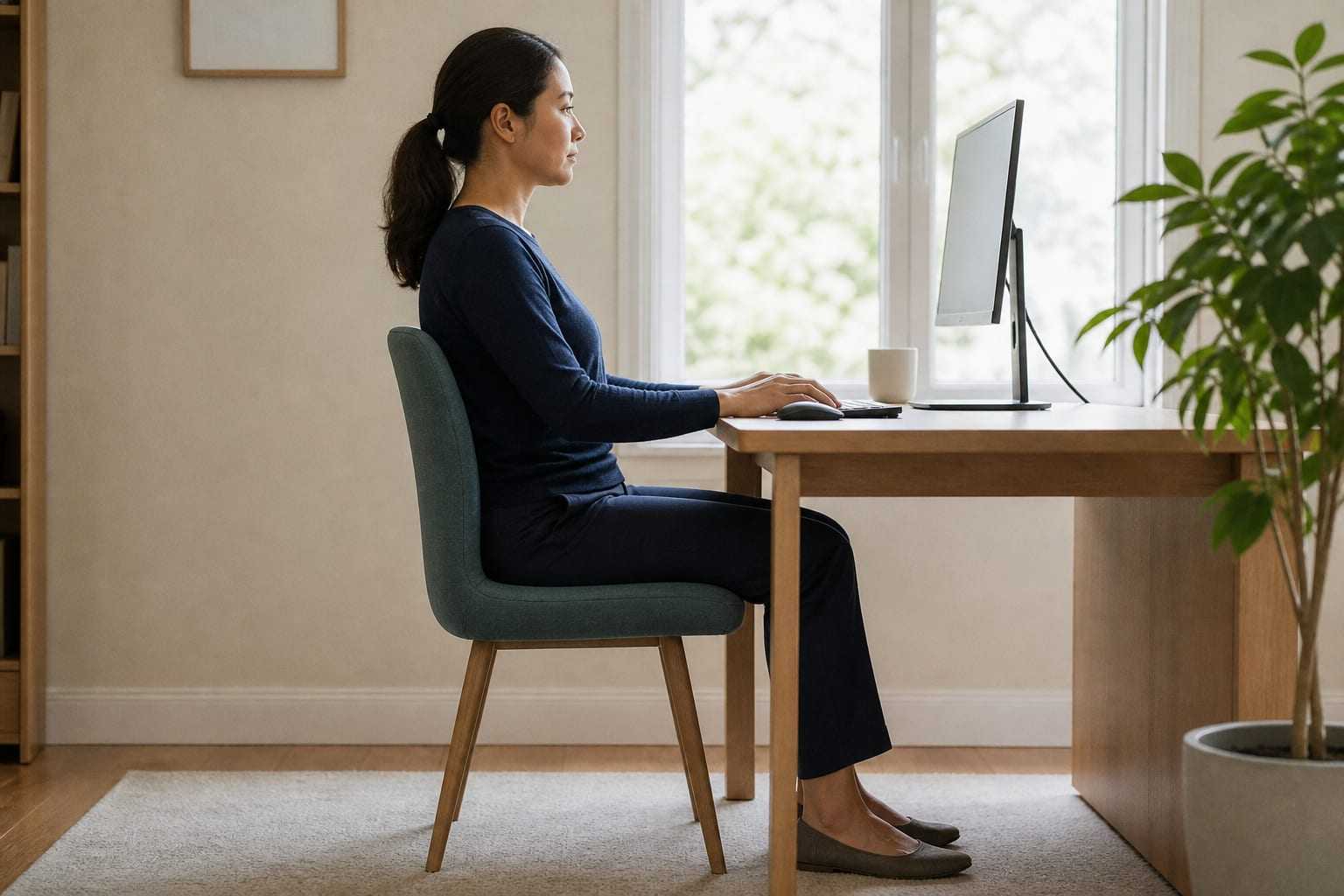
Many people who work at a desk attribute discomfort in the low-back region directly to sitting. This article addresses the relationship between prolonged sitting and load in the low-back region: why duration is more decisive than posture, what variety of positions means, which chair and desk support settings matter for the low back, and how standing-work options can be used.
For the general framework of low back pain, the concept of non-specific low back pain and the scope of a physiotherapy assessment, see the low back pain guide. The relationship of total sitting time to general health — that is, the heading of sedentary behaviour independently of the low back — is a separate topic and is addressed in the prolonged sitting guide. The focus of this article is the low-back region.
Sitting is not the low back’s “harmful thing”
The narrative that presents sitting as a risk on its own is both incorrect and unhelpful. Sitting is an ordinary part of daily life; many jobs are done sitting, and in a portion of people with low-back complaints sitting is relieving.
The risk that organisational sources on work-related musculoskeletal disorders point to is not “sitting” but these two:
- sitting or standing in the same position for a long time
- little opportunity to change position or take a pause
The difference matters: the first blames an activity; the second describes a working condition that can be changed.
Duration or posture?
In practice there are two variables: the position you sit in, and how long you stay in that position without interruption. The second is usually more decisive and easier to work on.
Ergonomics sources state this point clearly: however suitable your working position, remaining in the same position or remaining still for a long time creates an expected load. For this reason OSHA’s workstation guide does not define a single “correct sitting position”; it defines four reference positions that keep a neutral joint alignment and recommends moving between them during the day:
- upright sitting
- standing work
- declined sitting (hips a little higher than the knees)
- reclined sitting (trunk reclined about 105–120 degrees relative to the thighs)
All four of these positions are considered acceptable. So the aim is not “to find the perfect sitting position”, but to move among a few positions during the day. Trying to sit upright all the time is, for most people, both tiring and unsustainable for more than a few minutes.
Chair settings that matter for the low back
There is a great deal of detail in chair selection; the headings that stand out for the low-back region are limited:
- Back support and lumbar support. The backrest should meet the natural curve of the spine and offer an outward curve that sits in the hollow of the low back. This support being height-adjustable is decisive for fitting different trunk sizes. If your current chair has no lumbar support, a removable support cushion or a towel rolled into a cylinder can be used as a temporary solution.
- Ability to recline. It is recommended that the backrest can recline at least 15 degrees from vertical and continue to give support in that position. Being able to recline is one of the easiest ways to change position during the day.
- Seat-surface height. At a suitable height the whole of the sole of the foot rests on the floor and the back of the knee sits a little above the seat surface. If the chair height cannot be lowered (for example if the keyboard or screen would then sit too high), using a footrest is appropriate.
- Seat-surface depth. The surface should support most of the thigh without pressing on the back of the knee. A surface that is too deep leads the person to slide forward and not benefit from the back support.
- Arm support. Arm supports should be at a height that allows the shoulders to relax. Unsuitable arm supports tilt the trunk to the side or forward and change the load in the low-back region indirectly; if they cannot be adjusted, not using them is also an option.
How these settings relate to one another and how they are arranged together with desk height is set out in the desk and chair setup guide.
The indirect effect of desk height
If the desk is too high, the shoulders are drawn up and the trunk turns forward; if it is too low, the trunk leans forward. In both cases support in the low-back region is reduced. In practice the order is this: first the feet and sitting height, then the work surface and arm support, last the screen height. The screen itself is not directly decisive for the low back, but when it requires the trunk to reach forward it leaves the back support unused.
Standing-work options
The value of a standing desk is not that standing is a more suitable position than sitting; it is that it makes switching easier. Spending the whole day standing creates its own load and is a source of discomfort for some people.
A practicable way to use it:
- Choose work to do standing: reading, phone calls, short meetings, scanning email
- Start the time spent standing in short blocks and increase it gradually
- While working standing, also shift weight between the feet and, if needed, raise one foot slightly
- When you tire, treat sitting as part of the plan, not as a failure
Some work can be done standing even where there is no height-adjustable desk; what is decisive is not the equipment, but the distribution of positions during the day.
Active breaks and the behaviour of standing up
The way to make standing-up behaviour reliable is to tie it to a routine rather than to willpower:
- Tie the pauses to a task. Getting water, speaking on the phone standing, going to the printer.
- Keep them short and frequent. A few minutes on the hour is easier to sustain than half an hour once a day.
- Add movement. Instead of standing up and staying in place, walk a few steps and move the trunk and hips.
- Review the meeting pattern. Consecutive online meetings are one of the most common reasons sitting time lengthens without interruption.
- Write them into the calendar in busy periods. Breaks are the first thing sacrificed in the very periods when they are most needed.
The definition of an active break and how it is planned are addressed in the active break guide, and the overall arrangement of the work environment in the office ergonomics guide. At organisational level, examination of sitting behaviour, break organisation and the work pattern falls under sitting and work pattern and workstation analysis.
Long journeys and driving
When driving, the opportunity to change position is markedly reduced. On long journeys, planning breaks in advance, adjusting the seat’s lumbar support before setting off, and walking briefly at every stop are practical approaches. This shows that sitting time is a variable that needs to be accounted for across the whole day, not only in the office.
When should you see a health professional?
Low-back complaints related to the sitting pattern are mostly favourable in course. The following signs are uncommon; they are listed here not to create anxiety, but to make clear the situations in which asking for assessment, rather than waiting, is appropriate.
Signs that require urgent assessment:
- Difficulty passing urine, or a newly appeared change in bladder or bowel control
- Newly started numbness or loss of sensation in the sitting area, the groin and the inner thigh
- Loss of strength that appears in both legs together or is progressing
- A suddenly started change in sexual function
When these signs appear, one should not wait and should go directly to a health facility.
Other situations that need assessment without delay:
- Low back pain that started after a marked trauma such as a fall or a blow
- Numbness, tingling or loss of strength radiating into the leg and gradually increasing
- Fever, unexplained weight loss, or continuous pain that does not ease with rest through the night
- Newly started low back pain in the presence of a known history of cancer, long-term corticosteroid use, or osteoporosis
Situations in which making an appointment is reasonable:
- A complaint that does not ease as expected within a few weeks despite adjusting your work pattern
- Pain that affects sleep or the work day in a marked way
- Frequently recurring episodes
- Not being sure which settings and which loading pattern are suitable for you
For information about the individual assessment process, see the low-back and mid-back health page. If any of the signs defined as urgent above are present, go first to the nearest health facility.
This article is for general information and is not a personal assessment, diagnosis or treatment. The reason for your symptoms and what is appropriate for you can only be decided after an in-person assessment.
Sources
- OSHA — Computer Workstations eTool: Good Working PositionsFour reference working positions and the recommendation to change position during the day.
- OSHA — Computer Workstations eTool: ChairsErgonomics recommendations on back support, lumbar support, seat-surface height and depth, arm support and foot support.
- EU-OSHA — Musculoskeletal disordersSitting or standing for a long time in the same position, and limited opportunity to change position, being among the risk factors.
- NICE — Low back pain and sciatica in over 16s (NG59)National Institute for Health and Care Excellence, NICE guideline NG59. Assessment and management framework for low back pain.
Frequently asked questions
Does sitting for a long time cause low back pain?
Sitting cannot be shown on its own as the cause of low back pain. That said, remaining in the same position for a long time and having little opportunity to change position during the day are among known factors for work-related musculoskeletal complaints. In practice what is decisive is total duration, how uninterrupted it is, and the person’s capacity at that time.
Should I use a lumbar support cushion?
If your chair’s back support does not meet the natural curve of the low back, a removable support cushion or a towel rolled into a cylinder can be used as a temporary solution. The lasting solution is a chair with height-adjustable lumbar support. A support cushion can increase comfort; it is not a treatment method on its own.
Does a standing desk resolve low back pain?
The value of a standing desk is not that standing is superior to sitting, but that it makes it easier to change position during the day. Spending the whole day standing also creates its own load. The useful way to use it is to switch regularly between sitting and standing work.
How often should I stand up?
There is no single number that applies to everyone. The shared emphasis of ergonomics sources is that position should be changed frequently during the day. For most people, changing position every 30–60 minutes and standing up briefly on the hour is a practicable starting point; what is decisive is not the length of the interval so much as being able to sustain it regularly.
Should I try to sit upright when I have low back pain?
Trying to stay upright all the time usually increases muscle tension and cannot be sustained for long. A comfortable sitting position that uses the back support, and moving between a few different positions during the day, is a more realistic approach. Variety should be the aim, rather than looking for a single perfect sitting position.
Other articles on this topic

Low Back Pain: Non-specific Low Back Pain, Assessment and Staying Active
How common low back pain is, what non-specific low back pain means, what a physiotherapy assessment covers, and the principles of staying active and managing load.

Prolonged Sitting: Sedentary Time in the Working Day
What sedentary behaviour is, why total sitting time matters independently of posture, and how you can realistically build movement into the working day.
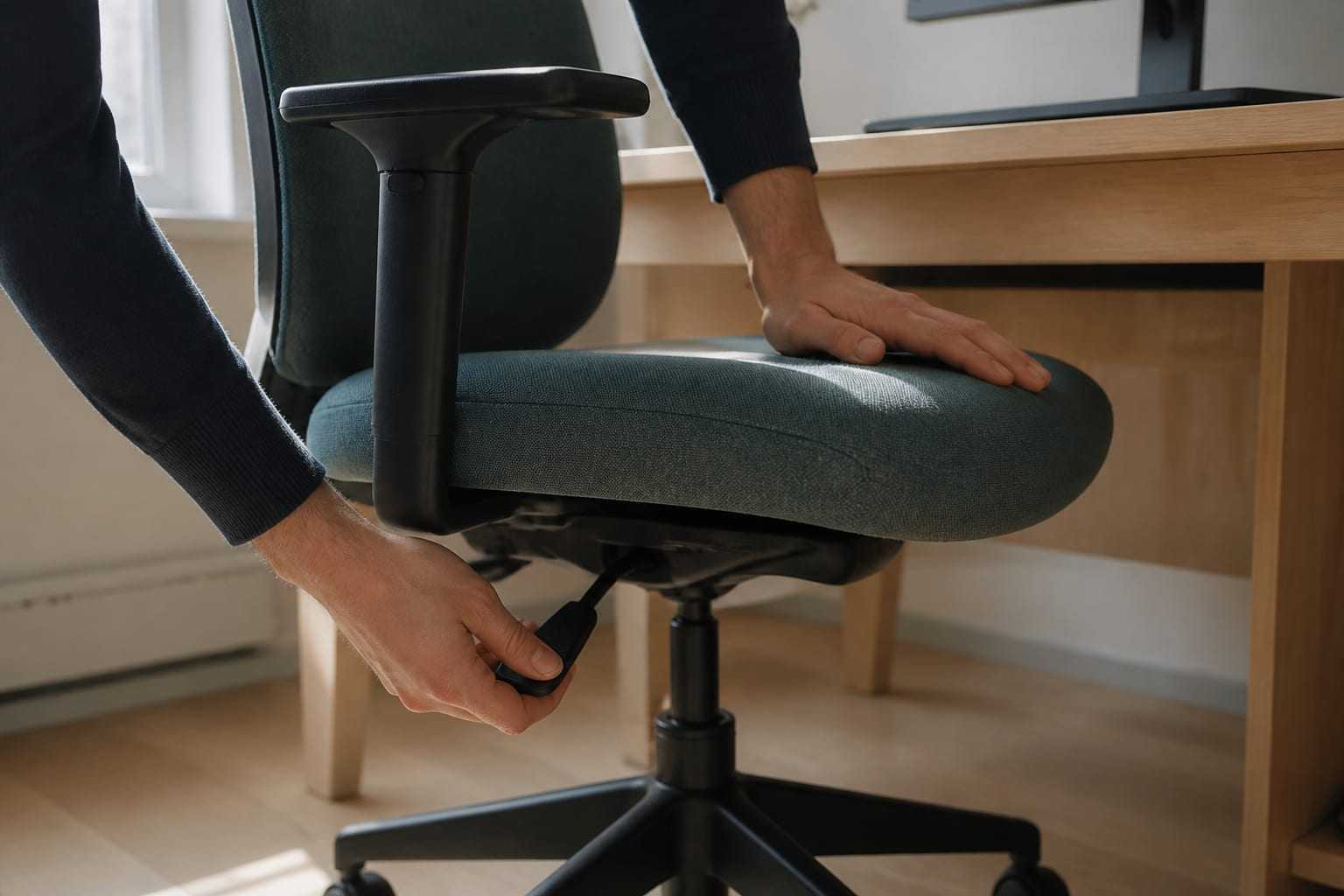
Desk and Chair Setup: A Sequenced, Practicable Path
In what order should you adjust an office chair and desk? We walk through height, seat depth, lumbar support and armrest settings step by step.